Welcome to Climate Conversations, a space where we bring together stories, voices and ideas about how people are responding to climate change. Here you will find videos, interviews, podcasts, webinars, and more that show real-life experiences from communities, researchers, and practitioners working on the ground, showing how these challenges affect people’s lives, affect decisions of where to work and live, and shape how we cope and build resilience.
In this seminar, researchers Chandni Singh (IIHS) and Amina Maharajan (ICIMOD) discuss climate-related migration in South Asia. Their conversation looks at how migration, mobility, and immobility serve as adaptation strategies amid climate risks, urbanisation, and social vulnerability, highlighting the need for inclusive, updated policy responses in the region.
This seminar, featuring Professor Neil Adger of University of Exeter, focuses on the intersection of migration, climate change adaptation, and the social concept of empathy as a means to address precarity among migrant populations in rapidly growing urban areas.
This seminar, hosted by the School of Global Development at UEA, features Professor Jonathan Rigg from University of Bristol, a renowned expert in human geography. His presentation critically examines the complex nexus between migration, climate change, and development, drawing on longitudinal ethnographic studies from Thailand, Laos, Vietnam, Nepal, and Sri Lanka.
This webinar features a comprehensive discussion with Professor Neil Adger, a leading human geographer renowned for his influential work on climate adaptation and human vulnerability. His talk at ICIMOD centres on the urgent need for a paradigm shift in how governments address climate adaptation, emphasising a long-term, mission-driven approach.
The seminar features Professor Robert McLeman of Wilfrid Laurier University in Waterloo, Canada, who shares insights on how the Intergovernmental Panel on Climate Change (IPCC) has addressed migration and displacement since the 1990s. He outlines key messages from the 2022 IPCC report, including how migration is a complex response to climate hazards, often moderated by non-climatic factors. He emphasises that most climate-related migration happens within a country and highlights the importance of immigrant agency and support for those unable to move.
This talk, led by social anthropologist Jelle J P Wouters of Royal University of Bhutan, reframes climate migration as a multispecies process involving humans, crops, plants, animals, water, and soil. Drawing on Himalayan examples, he highlights how nonhuman migrations, often overlooked, shape human movements and reconfigure relationships between beings. His lecture reveals climate change as a profoundly entangled, shared experience.
This seminar explores methodological advances in climate mobility research, focusing on how migration, displacement, and immobility are studied in the context of climate change. Dr. Robert Oakes (United Nations University – Institute for Environment and Human Security) discusses how research methods can better capture aspirations, capabilities, decision-making, and precarity in climate-related mobility.
This lecture examines climate change–induced internal displacement in Bangladesh, exploring whether migration can function as a form of adaptation. Professor Tasneem Siddiqui discusses precarity among displaced populations, gendered vulnerabilities, livelihood challenges, and health impacts, drawing on extensive qualitative research including photovoice methods.
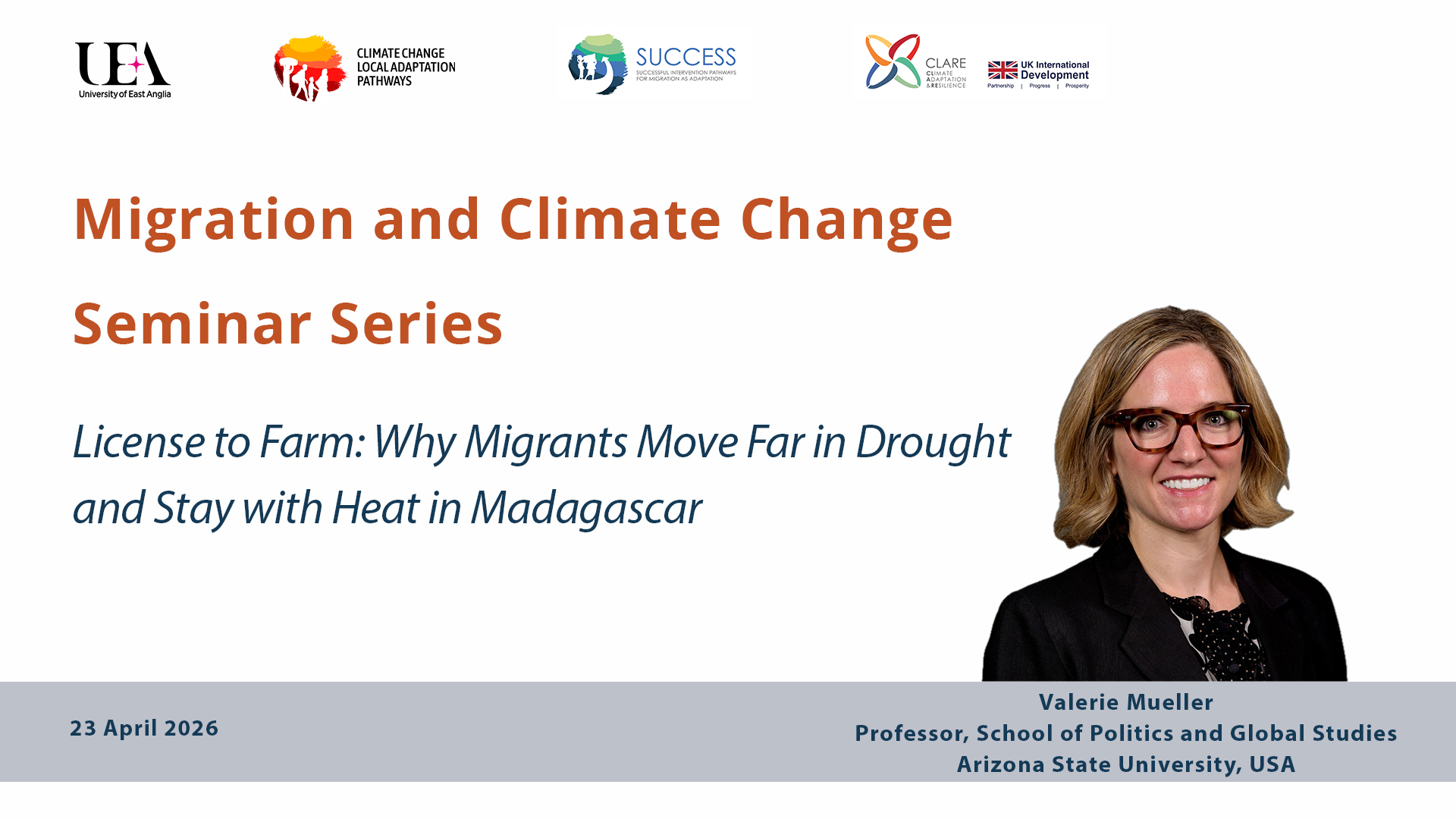
Featuring insights from Valerie Muller, this webinar explores how climate hazards such as droughts, floods, and cyclones influence migration decisions, using Madagascar as a case study. Drawing on findings from the CHAINE (Climate Hazards and Migration in Madagascar) project, the discussion challenges simplistic assumptions about climate-induced migration and highlights the economic, social, and household factors that shape mobility. It also examines debates around migration and deforestation, and considers why better data and stronger policy frameworks are needed. Combining climate science, economics, and social research, the session offers a nuanced understanding of migration in a changing climate.
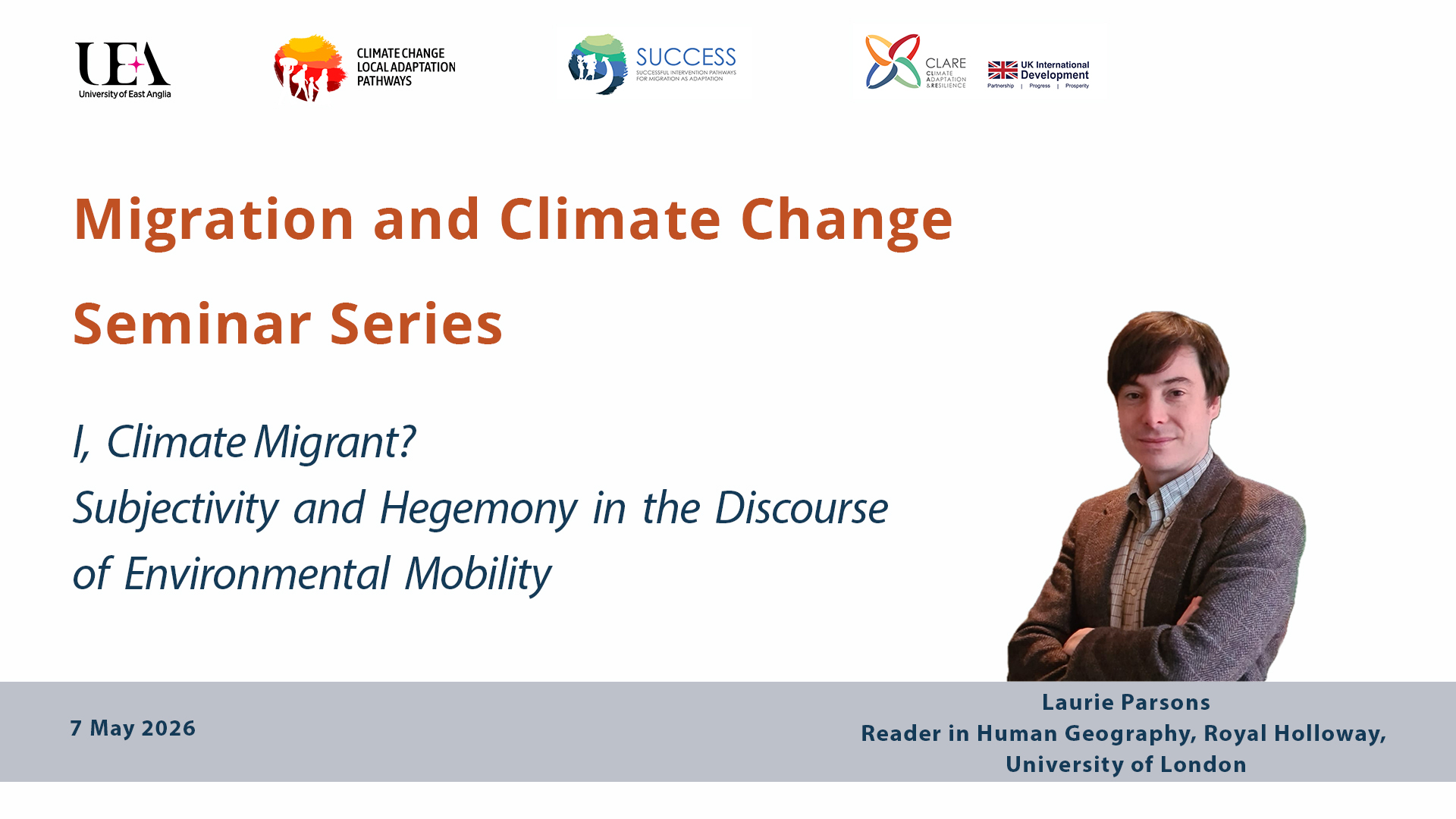
In this webinar hosted by the University of East Anglia, Laurie Parsons, Reader in Human Geography at Royal Holloway, University of London, examines climate migration through the lenses of power, inequality, and environmental justice. Drawing on his book, Climate Hegemony: Confronting the Politics of Environmental Impact, he explores how dominant narratives about climate migration are shaped, whose experiences are heard, and how mobility is influenced by labour, development, and global economic systems. Using examples from Cambodia and other climate-vulnerable regions, the talk challenges simplistic understandings of climate migration and highlights the complex social, political, and economic forces that drive movement in a warming world.
Interviews
In an interview with Sofia Juliet Rajan of IIHS, Professor Neil Adger, University of Exeter, discusses how climate change influences whether people stay or move, and why migration can be an active choice for adapting. He explains the importance of fairness, empathy, and social resilience, drawing connections between local realities and global responsibilities.
In an interview with Sofia Juliet Rajan of IIHS, Amina Maharjan, senior researcher at Nepal’s ICIMOD, draws on years of experience with mountain communities to show how migration can be a proactive response to climate change. She shares stories from post-flood recovery in places like Kagbeni, explores how shifting livelihoods and resources shape adaptation, and discusses the impact of gender and inequality.
Explainers
What’s the CLAPs project trying to do?
What is immobility and how is CLAPs examining it?
What are the costs and benefits of migration? A view from Odisha