skip to content
 

Resources

CLAPs produces a range of knowledge products not just directed at researchers and academicians but a wider audience including media, policymakers, the general public and communities directly impacted by climate change. Please click on the resources below to access the reports.

How Adaptation Drives Development and Growth

Category: Issue Brief

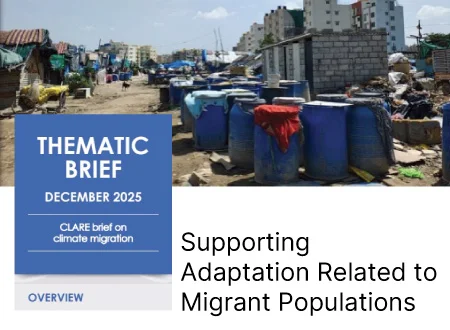
This brief provides on overview of work under the Climate Adaptation and Resilience (CLARE) programme that addresses key socioeconomic vulnerabilities and contributes to resilient economic growth. It shows how climate adaptation investments drive inclusive economic growth by strengthening resilience, productivity, livelihoods, and fiscal stability across key sectors in the Global South.

Differentiated outcomes of climate change-induced internal migration in India

Category: Journal Article

This article reviews how climate stress (drought, cyclones, saltwater intrusion) drives migration from rural/coastal areas to cities. It highlights that social factors such as caste, landholding, irrigation access shape how migrants adapt and build resilience. Many migrants end up in informal, insecure urban jobs and live in precarious housing, worsening inequality. The paper argues that whether migration works as “adaptation” depends heavily on how inclusive and resilient the destination cities are.

Living with Climate Risk: A Profile of Vulnerable Migrant Settlements in Ernakulam

Category: Report

Ernakulam has emerged as a major destination for internal migrants in India in the past decades. This profile has mapped five key migrant settlements to generate evidence on the living conditions, vulnerabilities, and adaptive capacities of migrant communities in the district, in the context of increasing climate risk. The insights can provide actionable knowledge for decision-makers seeking to strengthen social protection, enhance resilience, and integrate migrant settlements into development planning.

Adaptation Gap Report 2025 | Running on Empty

Category: Report

Amid rising global temperatures and intensifying climate impacts, UNEP’s 2025 Adaptation Gap Report: Running on Empty finds that a yawning gap in adaptation finance for developing countries is putting lives, livelihoods and entire economies at risk. The report updates the cost of adaptation finance needed in developing countries, putting it at US$310 billion per year in 2035, when based on modelled costs.

Perspectives on climate change in South Asia

Category: Commentary

This Viewpoint brings together nine South Asian researchers to examine climate-change perspectives in South Asia. It highlights regional vulnerabilities, research progress, policy gaps, and adaptation pathways. The article calls for strengthened regional collaboration, inclusive policymaking, and context-sensitive climate strategies to better manage risks and build resilience.

Crisis of imagination/(re)imaginations for a (climate) crisis

Category: Journal Article

This paper, emerging from the 2023 RGS-IBG theme Climate Changed Geographies, argues that human geography faces a crisis of imagination shaped by Western hegemony. It proposes reimagining climate change through the lenses of historical injustice, coloniality, diverse knowledges, solidarity, differential vulnerabilities, and an ethics of care, aiming for justice-oriented systems change.

Shifting Grounds: Telling the Climate Migration Story in India

Category: Guidebook

This guide supports communicators in development organisations, think tanks, and the media to navigate the often-overlooked links between climate change and internal migration in India. Drawing on field research, expert interviews, and narrative analysis, it explores how climate change-related events like floods, droughts, and heatwaves shape migration. The guide provides clear explanations of key terms, practical guidelines for ethical storytelling, and accessible data sources and tools. Framed as a resource for responsible narratives on rural–urban migration in the context of climate change, it highlights the importance of recognising migration-as-adaptation.

Category: Report

This report reviews 94 national, state (Karnataka and Kerala), and city-level (Bengaluru and Kochi) interventions to assess whether development, labour, and climate policies address the needs of internal migrants. It examines whether these initiatives strengthen migrants’ adaptive capacities using the Adaptive Social Protection framework, which links social protection, climate adaptation, and disaster risk reduction. The analysis explores whether India’s social protection systems are flexible and responsive enough to support people on the move in a climate-affected context.

Category: Commentary

This commentary critiques the adaptation science field, arguing that while adaptation theory and research have grown, they often fail to address practical needs. It highlights gaps in methodologies, interdisciplinary integration, and the underexplored role of behaviour change as a critical lever for societal and individual adaptation to climate change.

Category: Report

The Adaptation Gap Report 2024 highlights the urgent need for increased global action on climate adaptation to mitigate the severe impacts of climate change. It reveals significant shortfalls in funding and implementation, with developing nations particularly vulnerable due to financial constraints. The report underscores the necessity for systemic transformation, innovative financing mechanisms, and improved cooperation. It emphasises the importance of science-based strategies to bridge the gap between ambitions and actionable outcomes, ensuring resilience for the most affected populations.

Category: Policy Brief

The WASP Science for Adaptation Policy Brief No. 8 focuses on bridging critical gaps between climate adaptation science and policy, particularly for vulnerable regions. It highlights the importance of addressing transboundary climate risks, high-end warming scenarios, and early warning systems. The brief emphasises collaborative, interdisciplinary approaches to inform proactive, science-based policies for mitigating loss and damage.

Category: Journal Article

This article, published in International Migration Review, introduces the Migration Intersections Grid (MIG), a comprehensive framework for organising and guiding migration research. Through a scoping review, it identifies 12 key components of MIG and demonstrates its intersectional, interactive nature for addressing emerging migration issues.

Category: Journal Article

This article, published in The Indian Journal of Labour Economics, examines labour migration to Kerala, finding that the state offers high wages and social security measures for migrant workers. While some policies struggle with implementation, Kerala’s disaster response experience aided their support during the national lockdown.

Category: Journal Article

This article, published in One Earth, calls for better research on climate-driven migration, including factors that influence its effectiveness and the need for policies that respect individual agency.

Category: Journal Article

This article, published in Proceedings of the National Academy of Sciences, explores how migration affects societies and environments. It proposes a framework to analyse these impacts, aiming to integrate migration into sustainable development without harming equality or the environment.